
Most people approach home improvement financing with the same cautious optimism a gambler brings to a slot machine. They browse Pinterest boards filled with subway tile and quartz countertops, thinking a little credit will bridge the gap between their current reality and that dream kitchen. They’re wrong. If you treat a renovation as a “fun project” instead of a calculated capital investment, you’re going to end up drowning in high-interest debt that eats your equity and kills your monthly cash flow.
Renovating a home isn’t a hobby; it’s a high-stakes financial maneuver. When you decide to tear out a bathroom or expand a deck, you aren’t just buying materials. You are leveraging your future income to pay for present luxuries. If you don’t understand the math behind the loan, you aren’t a homeowner; you’re a victim in the making. Stop looking at what the renovation will look like and start looking at what the interest rate will do to your net worth.
I’ve seen people spend fifty thousand dollars on a kitchen remodel using a credit card with a 24% APR. That isn’t an investment. That is financial suicide. You need to walk into this with a clear-eyed understanding of which tools are actually meant for the job and which ones are designed to bleed you dry.
The Unsecured Advantage and the Hidden Cost of Speed
Unsecured personal loans are the heavy lifters here. These loans don’t require you to put your house on the line as collateral. That’s a massive distinction. If you use a home equity product and the project goes sideways or you lose your job, the bank can come for your roof. With an unsecured loan, they can’t touch the house, though they can certainly ruin your credit score.
The main draw is speed. You can often get the funds in your bank account within a few days. If your water heater explodes or your roof starts leaking, you don’t have time to wait six weeks for an appraisal. You need cash, and you need it now. But that convenience isn’t free. Because the lender is taking more risk by not having your house as collateral, the interest rates are naturally higher than a mortgage-backed loan.
Look at the current market. For instance, Marcus offers unsecured personal loans with rates ranging from 6.99% to 24.99%, which shows the massive spectrum of what you might face depending on your credit profile. If you have stellar credit, you might get a rate that feels manageable. If your credit is mediocre, you might as well be setting your money on fire. Be honest about where you sit on that scale before you even start browsing contractors.
When you compare lenders, look past the monthly payment. The monthly payment is a vanity metric. It’s a way to make a massive debt look digestible. Instead, look at the Total Cost of Borrowing. A lower monthly payment over a six-year term might feel better today, but you’ll end up paying thousands more in interest than if you took a higher payment over three years. It’s a classic trap designed to make you feel comfortable while you’re actually losing ground.
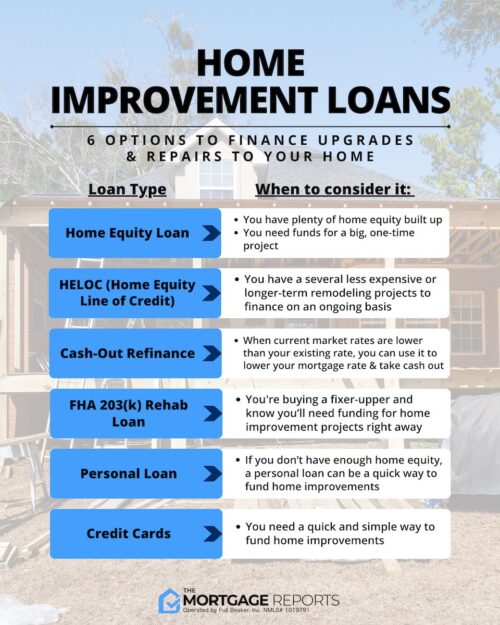
- Unsecured Personal Loans: Fast funding, no collateral, higher interest rates, fixed terms.
- Home Equity Loans: Lower rates, uses your house as collateral, slow to get cash, potentially tax-deductible.
- HELOCs: Variable rates, only pay for what you use, high risk if rates climb.
- Credit Cards: Immediate access, terrible rates, easiest way to ruin your debt-to-income ratio.
Why Your Credit Score Dictates Your Renovation Budget
You can have the most ambitious architectural plans in the world, but if your credit score is a mess, those plans are essentially fiction. Lenders aren’t in the business of helping you fulfill aesthetic dreams; they’re in the business of managing risk. A high credit score is your only leverage in negotiating a rate that doesn’t make your eyes water. It is the difference between a productive investment and a debt spiral.
Many homeowners make the mistake of applying for multiple loans at once to see who gives them the best rate. Stop that. Every time you hit “submit” on a hard inquiry, you take a small hit to your score. If you do it five times in a week, you’re signaling to every lender that you are desperate for cash, and they will price you accordingly. Do your research, use soft-pull pre-qualifications, and only pull the trigger when you are ready to commit to a specific lender.
I’ve talked to people who thought they could “fix their credit” while they were in the middle of a kitchen remodel. That’s a delusional strategy. Fix your credit *before* you decide you need a new floor. If you try to borrow against a shaky foundation, the whole structure of your personal finances will eventually collapse. You might find that texasloanstoday.com or similar local resources offer different perspectives on how much you can actually afford based on your specific regional costs and income levels.
Do you actually know your debt-to-income ratio? If you are already carrying a heavy load of student loans or car payments, a new personal loan for a bathroom remodel might be the straw that breaks the camel’s back. Lenders look at your total monthly obligations against your gross income. If that number is too high, it doesn’t matter how much equity you have in your home; they will reject you or hit you with a predatory rate.
| Credit Tier | Likely Interest Rate Range | Impact on Project Scope |
|---|---|---|
| Excellent (740+) | Low (Single digits to low teens) | Full renovation possible |
| Good (670-739) | Moderate (Mid teens) | Small upgrades only |
| Fair (580-669) | High (18%+) | Repairs only, no luxury |
| Poor (<580) | Extremely High (25%+) | Virtually no options |
The Math Behind the Material Choices
The biggest mistake people make is failing to account for the hidden costs. You think you need a $10,000 loan for new cabinets. You forget the $3,000 for the plumber, the $2,000 for the electrician, the $1,500 for unforeseen rot behind the drywall, and the $1,000 for permits. Suddenly, your $10,000 loan is insufficient, and you’re back to square one, staring at a half-finished kitchen and an empty bank account.
When you use a personal loan for a project, build a 20% contingency buffer into your loan amount. If the contractor hits a snag, and they always do, you need the liquidity to handle it without begging for a second loan. Borrowing more than you need is bad advice, but borrowing less than you need is a catastrophe. It’s a balance most amateur renovators completely miss.
I’ve seen people try to “save” money by choosing cheaper materials, only to realize that the labor costs for cheap materials are often higher because they’re harder to install. It’s a vicious cycle that drains your budget faster than a leak in a bad pipe. Look at the long-term value. A new bathroom might add $15,000 to your home’s value, but if it cost you $20,000 in interest and labor to install, you have effectively lost $5,000.
Treat your contractor like a business partner, not an employee. Get everything in writing. Do not rely on verbal agreements or “handshake deals” that disappear the moment the drywall is up. If you are using a personal loan to pay them, ensure the payment schedule aligns with the milestones of the work. Never pay the full amount upfront, and never pay the final installment until the punch list is 100% complete and you have inspected the work yourself.
The reality of home improvement is that it’s often more stressful and more expensive than any homeowner anticipates when they are looking at pictures on their phone. You are essentially running a small construction company out of your own living room. If you aren’t managing your capital with extreme discipline, you will fail. It’s not about the tiles; it’s about the math.
Navigating the Comparison Trap
The internet is flooded with “best of” lists that are essentially glorified advertisements. You will see endless comparisons between credit cards, home equity lines, and personal loans, and most of them are designed to lead you toward the easiest product to sell, not the one that’s best for you. Learn to see through the marketing. A “low monthly payment” is often just a way to hide a long-term interest burden that will haunt you for a decade.
When comparing options, look at the term length. A 72-month loan might look much better on paper than a 36-month loan, but when you do the math, the extra two years of interest might cost you as much as the renovation itself. Ask yourself if you want to be paying for your 2024 kitchen when you are trying to buy a new car in 2030. The timeline of your debt matters as much as the amount.
Compare the actual terms, not just the teaser rates. Some lenders will offer a low rate but hide massive origination fees in the fine print. A 6% rate with a 5% origination fee is actually much worse than a 7% rate with no fee. You need to calculate the “effective” interest rate to see the truth. It’s tedious and boring, but it’s exactly what you need to do if you want to avoid being the person who’s perpetually “renovating” because they can never actually finish anything.
The best way to finance a project is to use the cheapest money possible for the most important parts. If it’s a structural necessity like a roof or foundation, use a low-interest home equity product. If it’s a cosmetic upgrade like painting or backsplash, use a short-term personal loan or even cash if you have it. Stop treating every renovation as a single, monolithic financial event. Break it down, analyze the risks, and don’t let your desire for a pretty house blind you to the reality of your bank statement.
Stop borrowing money you can’t afford to pay back just because the tile looks good.